Saturday, September 7, 2013

Exodus


Title: Exodus

Author: Leon Uris

Publication date: 1958

Book's setting: 1940's

Random facts: I wanted to know more about the formation of Israel but of course I didn't want to read a 600 page nonfiction political debrief so I settled for this.


Plot summary: American widow and journalist friend get involved in the smuggling of Jewish POV/refugees out of Greece post WWII and into Palestine. The book then breaks off into several historical recounts of Jewish oppression based around a particular character in the book, wrapping it all together by the second half with an intense play-by-play of the United Nation's decision to see Israel as its own nation, and finishing emotionally with lots of people dying.


Favorite aspects: Epic. I mean, I was enthralled. Historical fiction is so amazing because you learn and you can be emotionally involved and your knowledge of history at the outset helps you become much more engrossed than you might have been. I had absolutely no clue that half the stuff in this book happened, so I think it was good for me to read it, but at the same time my knowledge of the historical context totally enhanced the experience. And like, on a totally personal level, DOV AND KAREN. I'm a sucker for those sorts of romances.


Least favorite aspects: I was surprised that there wasn't more about the Spanish Inquisition. The book went back to retell stories of of Jewish oppression in multiple countries as far back as the early 1800's, but I think it would have been really awesome for that to be included.

Other works it reminded me of: Maggie-Now by Betty Smith, The House of Spirits, Isabel Allende


Sadie's merciless break-down: Fact: I read this on the plane on my way home from Switzerland and it was like 3 flights and a layover and a few amazing meals and lots of white wine and this book. Reading it was intense. It's an intense book. The writing is a little "of the times" but not in a bad way. I dunno. It was awesome. 


Recommendation rate: Any historical fiction fan should read this.

On Chisel Beach


Title: On Chesil Beach

Author: Ian McEwan

Publication date: 2008

Book's setting: 1960's

Random facts: I bought this for 99 cents in a used bookstore because it was so tiny I could bring it home in my purse.

Plot summary: A young couple (virgins) on the eve of their wedding, in a society on the cusp of a sexual revolution (that they're like a tad to old to catch) and what happens that night. The middle of the book is a recount of the courtship but the first 50 pages or so, and last 50 pages or so is purely moment-by-moment recount of their evening.


Favorite aspects: Beautifully written. I mean, insanely amazing prose. This is the man who wrote Atonement, so I expected nothing less. So quotable, so emotional. I felt like I was in the skin of both characters as they took in their environment, tried to swallow their fears. The book is quite grounded in its historical period as well. Some very funny quips about England at the time, politically. Interesting insight into the society through this microscopic story.


Least favorite aspects: I think that I was expecting something a little more driven by the end. I'm not sure what the core was. McEwan used two very separate voices sharing their own experiences, but it wasn't much more than experiences. The epilogue-type part at the end was weird. I think that the book didn't really need it. Or, if McEwan was going to give us a glimpse of the future (after the wedding night events) than he really should have hit us in the gut. Instead I felt like I was reading the five page version of One Day by David Nicholls.

Other works it reminded me of: One Day by David Nicholls.

Sadie's merciless break-down: I enjoyed it more reading it than I did in retroscept. It was one of those novels where the prose, the insensity of the reading process, the emotional insensity- that's what made it so good. Now... looking back, I don't really care much what happened in the book. (Unlike Atonement, where I think I'll take that trauma to the grave.)


Recommendation rate: Only if you don't mind sad books. Or if you are a sucker for perfect prose.

Thursday, January 3, 2013

Brooklyn


Title: Brooklyn

Author: Colm Toibin

Publication date: 2009

Book's setting: 1950's

Random facts: Recommended to me by my friend Rachel, who read it in a college class.

Plot summary: Eilis is a young women living in her home country, Ireland, in the 1950's, unable to find work and dragging her family down. Her sister Rose, the more profitable sister, recommends she goes to America for work. Brooklyn is a very small story about a very short period of time in Eilis' life. Unlike many immigrant stories, Brooklyn is less about the immigrant plight and more about Eilis as a person, as she meets and falls for a Italian boy and has to make hard choices.


Favorite aspects: It was just beautifully written. Flooring. I was reading it so slowly, just savoring every word. Like I said before, it's a delicate story about one girl's adventure. It all felt so real and crisp.


Least favorite aspects: I don't know. It's rare, but I don't think if I was God I'd rush in and change anything about it. It's a gem.

Other works it reminded me of: Maggie-Now by Betty Smith

Sadie's merciless break-down: The book ends poising a little question of: was she maybe taken advantage of? Did she make the right choice? I don't know. I think she did.
The romance was very harsh and realistic. Beautiful, exciting, but still laced with the sexism of the time. I spent a lot of the book worried about Eilis, for even though she was not courting a bad man, her naivety kept me feeling protective of her. I don't know. You read it and tell me.

Recommendation rate: I think everyone who likes to read should read this. If you love history you need to run out right now and buy it.

Wednesday, January 2, 2013

There. And Back. Again.

Apparently I'm insane because I think I'll try and bring this blog back. I don't have time to review every book I've read, so I'm gonna review my favorites since I last blogged, and then will be (every now and then) reviewing books I particularly loved.

So yeah. 

This is your fault Brittany. You blogged and I was all like, damn, it's been a while since I've seen the written word. Tumblr is fun, but so freaking condensed, I feel guilty writing more than two complete sentences together.

So yeah. I am obviously insane.

Also although I try like mad to find my errors, I am notoriously a bad speller. So, apologies in advance. Hopefully, at the very least, I can spell the titles of the books correctly.

Lastly, the font I previously used seems to no longer be an option, so I guess I'm going with something different now? Ok. 

Peace, Sarah D (Sadie)

Friday, January 13, 2012

I'm Back

I'm back and I'm going to continue writing a review about every book I read. However, even though I am about six months behind I intend to review them all in order of how I read them. It might take me a few months to catch up, maybe I never will.
But I read 80 incredibly good books this year, and I think they deserve to be written about. Enjoy!

Monday, October 10, 2011

Perks of Being a Wallflower


Title: Perks of Being a Wallflower

Author: Stephen Chbosky

Publication date: 1999

Book's setting: 1991

Random facts: Percy Jackson and Hermione Granger are leading in the movie, out next year.

Plot summary: Middle-class suburban Charlie starts high school, and needs a way to vent his emotions, fears, and secrets if he's going to survive. Instead of a diary, he writes letters to an anonymous friend whose name the reader is never given. These letters make up the book. Charlie accidentally finds himself on the fringes of a crowd of amazingly cool seniors. The book deals with issues all teens face with sincerity and grace.

Favorite aspects: Oh, was it perhaps a bit too fraught with emotion? A tad too sincere? Yeah. But somehow that excess of incredible emotion was what made it so relate-able and real and sorrowful. Charlie himself was such a sympathetic character. He was a bit much at times... but the surprising ending made sense of that. Actually I think the characters in general made it so strong. Anyone can write a book about dysfunctional teenagers- substance abuse, drunken riots, closeted homosexuals, pregnancy scares, college application terrors. Not everyone can make you care that these kids are experiencing any of this stuff. I even genuinely cared for Sam, who is the stereotypical crazy beautiful bitch. however, is characters are the strongest point of the book, the characters I was most drawn to were Mary Elizabeth and Brad. Bravo,
Chbosky. It takes a lot for me to love a teenager.

Least favorite aspects: I was (and still am) a bit confused as to how writing the novel in letter form helped the structure. I don't know if it symbolizes something I'm missing... or if it's just a clever way making it autobiographical without being a diary... But it doesn't make a whole lot of sense. I often caught myself wondering more about what the hell was going on on the other side of the correspondence than about Charlie's own life. If someone was writing me letters like Charlie's, I'd want to respond and help. Maybe no one was receiving the letters. I'm not sure.

Other works it reminded me of:
Criss-Cross by Lynne Rae Perkins.

Sadie's merciless break-down:
It's one of those really famous books, so I was hesitant. It's a hipster classic right up there with The Bell Jar, On the Road, and Oscar Wao. So I was hesitant. But it was one of those books that really deserve the excessive hype they get. To be quite honest, I think it unfortunate that it fell into the hands of the hip booklisters and ended up on the shelves in Urban Outfitters next to Dirty Italian and The Quoteable Stoner. It doesn't belong there. Was it the best book ever? No, probably not. But it was a beautiful, heartfelt, and sincere book that deserves more than its overly ironic fanbase of the grown-up teen scene of the 90's. As excited as I am for the movie, and as excellent as the casting is, I once again don't know if it's actually going to do the novel any favors. Oh well. At least people are reading it.

Recommendation rate: It's a teen book. It's about teenage problems. If you're okay with that, it's one of the best teen books I've read.

Sunday, October 9, 2011

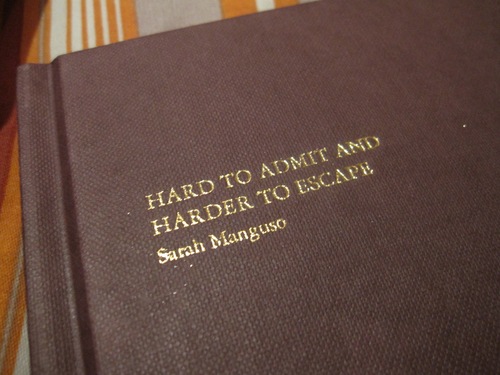
Hard to Admit and Harder to Escape


Title: Hard to Admit and Harder to Escape

Author: Sarah Manguso

Publication date: 2007

Book's setting: Modern America

Random facts: This book is one in a set of three short
stories call One-Hundred and Forty-Five Stories in a Small Box.

Plot summary: This is a collection of eighty-one short stories. Really short stories. Each one is limited to the length of a page, some are ever smaller. Although many of them stand alone, if you read them carefully enough you'll find that many of them seems to be about the same people, or child. Many of them sound incredible real, perhaps even autobiographical.

Favorite aspects:
I cried over some of these, they were so delicate and perfect. Manguso's writing is so seamless and easy to sink into. It's a tiny little book, only eighty-one pages, and you could totally read it in a single sitting. But that's one of the coolest things about it. It's an experience to read. It's theatrical. It's spell-bounding. You want to read it all at once.

Least favorite aspects: You can only buy it in a set of three books, for about $27. I choked and bought it... so what? Money is meant to be spent.

Other works it reminded me of: No One Belongs Here More than You by Miranda July.

Sadie's merciless break-down:
Let me quote one of the stories to you:
"There's one girl in the nursery that I decide to love. I stare at her and try to think of what I should call her. I decide I will call her Benny, and I approach her. "Hi, Benny," I say. Another girl pipes up. "It's Becky, not Benny," she informs me. But what she doesn't know is that I got within one constanant of the girl's name just by looking at her."

Recommendation rate: A must-read. All Manguso is a must, must, must read.

Thursday, August 18, 2011

Keturah and Lord Death


Title: Keturah and Lord Death

Author: Martine Leavitt

Publication date: 2006

Book's setting: Late medieval, somewhere.

Random facts: So I am rather behind on reviews. I'm still reading, I just haven't had time to review. Summer, whatchagonnado?

Plot summary: Keturah is a peasant girl, raised by loving grandparents in a small village. She sees her grandparents as a shining example of true love, and is dedicated to finding a True Love for herself. Her quiet life is disturbed the day she follows the legendary hart deep into the forest finds herself lost. After days of wandering aimlessly she knows that she is about to die, and Death comes. Except Death is a handsome Lord who she feels pity for. Desperate to live, Keturah challenges Death. She uses her storytelling skills to make him grant her a reprieve for one day. She tells a story of a love so pure that even Death cannot destroy her chances. He allows her to live another day on the condition that she come to him with an ending to the story and her true love. Can she find love in such a short time, and help her friends find their own? Can she continue to challenge Death when the plague reaches her beloved village?

Favorite aspects:
This might sound dorky, but the message was really beautiful. I also really loved all the villagers. Leavitt creates such a real little world! In that way it reminded me of Shannon Hale's books, but I think that Leavitt's story was much more delicate and metaphorical and downright artistic than Hale's teenager fantasies.

Least favorite aspects:
I found the incredibly old fashioned narrative to be rather hard to sink into... I don't know why. It's not like I am not accustom to reading older book, even incredibly old books. Actually my inability to really sink into the words worried me, because the novel I am working on has a very similar style, and now I am rethinking the entire style.

Other works it reminded me of: The Princess Academy by Shannon Hale; Tales of Beedle the Bard by JK Rowling; Beauty by Robin McKinley; Wildwood Dancing by Juliet Marillier.

Sadie's merciless break-down:
Truth timez! I didn't really enjoy this book much, mainly because I was not properly focused while reading it. It was beautiful, the story was gorgeous. The very concept makes my heart flutter. But I sort of just read the words dutifully.
I read it soon after arriving home from Germany, with a pile of seven books waiting for me. I had to get back to work, I had a couple of very overwhelming personal things to deal with. It was just the wrong time to read it. Keturah and Lord Death is exquisite. I'd recommend it in a heartbeat. I'm looking forward to reading it again in a few months, or even years, and being able to give it the respect it deserves.

Recommendation rate: If you like fantasies and all that, then you've gotta try it. Sadly it is out of print already, but check the library.

Thursday, August 4, 2011

The Rescuers


Title: The Rescuers

Author: Margery Sharp

Publication date: 1959

Book's setting: Sometime in the vague early 1900's.

Random facts:
R-E-S-C-U-E RESCUE AID SOCIETY HANDS HELD HIGH TOUCH THE SKY YOU MEAN EVERYTHING TO ME.

Plot summary: So there is this massive society of mice. The Prisoners Aid Society. And their job is to comfort depressed prisoners around the world. There is this really sad poet who is imprisoned in the most terrifying prison of all time, in Norway. The only mouse who can get access to this prison is high class Miss Bianca. She's completely out of her depths in the dark and murky world of Norway's jails, but she's just brave enough. Besides, Barnard had asked her so nicely. Along with the help of Nils, a Norwegian sailor mouse, Miss Bianca fights cats and all manner of terrifying things, to save the sad poet.

Favorite aspects:
I think that the illustrations were my favorite part of the book, which I know it actually cheating, but it's true. Either way, it was darling. I was very delicate and sweet and touching and careful and everything a good childrens book should be. I was actually very impressed, I wasn't anticipating liking it so much.

Least favorite aspects:
I actually had a bit of a hard time falling into the writing. It was a bit old fashioned obviously, but I read tons of old(er) books and have always really enjoyed the stately language. This was probably more an error on my part, like I was really tired or something when I read it.

Other works it reminded me of: The Wonderful O by James Thurber.

Sadie's merciless break-down:
The Disney movie of the same name was one of the most important things in my childhood. No lie. As much as I loved this book, it wasn't the Disney movie. Actually, it was probably better than the Disney movie, but it was still incapable to affecting me the way the cartoon did when I was a kid. Obviously. That's not exactly surprising, just confusing. Much like Ronia, this is a book I wish I had ten years ago.

Recommendation rate: If you are a big children's lit fan, then check it out.

Monday, August 1, 2011

No One Belongs Here More Than You


Title:
No One Belongs Here More Than You

Author: Miranda July

Publication date: 2007

Book's setting: Modern

Random facts:
200+ pages and I read it in a day, forsaking all else.

Plot summary: A collection of short stories written in that compelling and emotional voice that is ~modern~ literature. The stories are just little pictures of life- different lives and different heart break. Some of them are very odd, bordering upon metaphysical I'd almost say. Except it's not really the story itself that is otherworldly, it's just the way it's told.

Favorite aspects: All the emotions were sincear and they all felt so close to home... I even identified with the ones that I really had no reason to. I felt the character's pain in a way that is very rare, especially in short stories when none of the characters are actually fully developed.
I have an easier time reviewing the books I didn't love. I loved this. I loved it. I think my favorite stories were The Swim Team, This Person, and How to Tell Stories to Children. The last one broke my heart in the most epic way of all time.

Least favorite aspects:
I don't think I can think of anything... Sorry.

Other works it reminded me of: The Complete Short Stories of Evelyn Waugh by Evelyn Waugh; The Two Kinds of Decay by Sarah Manguso.

Sadie's merciless break-down:
I'm in an incredibly vulnerable place in my life right now, so prehaps it isn't any wonder I cried. Even so, I don't cry often.
So there is this style of writing. It's called "modern." And I've realized I love it. I'm cautious with it because it can be easily abused, or at least I think it can be. I don't think it possible that all "modern" writing could possible be as meaningful as No One Belongs Here More Than You. It's like poetry in proses form. It has a new set of rules and it's rhythmic. I'm a bit afraid of modern literature because I think it's more emotionally powerful than older styles of writing. It can grab you and haunt you so easily. I think that's because emotion is the point of modern literature. Not theme or morals or social commentary- the point is conveying emotion and making the reader feel it too. So in that sence it's a bit frightening, but it can also be compelling and eye-opening and really, really exquisite.
Note: Because I don't know who reads this blog or what their personal standards are I just feel the need to note that this book has sex and cursing in it. You have been warned.

Recommendation rate: It's a pity you can't force someone to read because you should all be forced to read this.

Ronia the Robber’s Daughter


Title: Ronia the Robber’s Daughter

Author: Astrid Lindgren

Publication date:
1981

Book's setting: Medieval timesish

Random facts: It was turned into a film in Sweden, one that did incredibly well. And then it was turned into a stage play in Germany.

Plot summary:
Ronia is the only daughter of Mattis, the chief of a band of thieves in the forest. Ronia grows up as the only child in a world of men until she meets Birk, the only son of Mattis' rival. The two bands of thieves have fought for years, but become forced to unite for their children's sake.

Favorite aspects:
Childhood romances are my kryptonite!! Okay, so it was more like a friendship, but you know what I mean. Cute little playmate stories are my kryptonite. It was just a charming story. It's really short... I read it in an afternoon... but it's still worth reading if you like children's literature. It's by Lindgren, so you know it's hysterical as well as charming.

Least favorite aspects: It's funny, I think I am just a bit old for this book... Or rather, I enjoyed it because I knew I'd have loved it as a child. It's a book I'd love to give a little girl, more than actually read again for my own personal pleasure.

Other works it reminded me of: The Minstrel in the Tower by Gloria Skurzynski.

Sadie's merciless breakdown:
I have a long list of book I want to give a little girl one day. Not even my own daughter necessarily, but any little girl. I want to give her Ransom for a Knight and The Minstrel in the Tower and The Maude Reed Tale... and I want to give her Ronia the Robber's Daughter. I'm sure eventually one of my sisters or friends will have a daughter... and when that happens I have a large stack waiting for her.

Recommendation rate: Buy it as a present for your niece.

Bleak House


Title: Bleak House

Author: Charles Dickens

Publication date: 1853

Book's setting: Early 19th century

Random facts:
I read this book because of Gillian Anderson and Carey Mulligan. Also because I was bored.

Plot summary: So there is this massive court case over the fortune of a guy who has been dead for a really long time. The case is called Jarndyce and Jarndyce. In a way Bleak House has two plot lines, that don't come together till the very end. The first plot line is regarding three young orphaned wards of the court- Esther, Ada, and Richard. They are taken in by a Mr. Jarndyce, one who wants nothing to do with the case and discourages his young wards from getting involved. Romance and tragedy and inevitable entanglement with the case draw the three young adults together toward their uncertain futures. The other plot line centers around one Lady Dedlock. Lady Dedlock has a secret, one that her husband's lawyer is hellbent on uncovering. This second strand of story unfolds like a whodunit mystery, pulling in all manner of classic "Dickens" characters. By the end of the thousand page novel, the two stories are binded together in more way than one.

Favorite aspects:
Ada and Richard. I stumbled and crawled and cried through the dull parts and the political parts and the massive chapters filled with old men yelling at each other for Ada and Richard's sake. I never thought Dickens could be capable of such a subtle, sweet romance. I want to buy my own copy and just highlight all the sweet Ada and Richard bits and read those alone over and over. (And just ignore their tragic end.) The other best part was Lady Dedlock. I'll go through the book with a different colored highlighter and cover all the amazing, tragic, heartbreaking thoughts of Lady Dedlock. Maybe the fact that I'd seen the miniseries helped bring these characters to life in a fully emotional way... or maybe Dickens is just capable of much more romantic subtlety than I had thought.

Least favorite aspects:
Those stinking Smallweeds. I sort of glazed over those parts. I mean, "shake me up Judy!" gets boring after a while. I feel like I needed an index of characters and back stories and family secrets while reading Bleak House. Maybe I'm just a bit too lazy to give it the attention it desires. Oh well. Nothing regarding Snagsby or Jo will be highlighted or given too much thought.

Other works it reminded me of: Let's be honest. Dickens is only ever really like other Dickens.

Sadie's merciless break-down:
So, remember two months ago when I begrudgingly had to admit I liked Little Dorrit, but was pretty certain I wouldn't be throwing myself into any more Dickens anytime soon? Well. I guess that plan fell through.
I took it out from the library because I was going on vacation and I needed something incredibly long and not too interesting to read on the plane, and in bed every night while in Germany. I needed something interesting enough that I'd actually read it, but nothing so good that I'd forsake enjoying myself for the book. So I read it on the plane and in bed and while my friends were napping before dinner was served. I read it while charging my mp3 player and while drinking a beer in the evening. I read it in fits and burst and skimmed the parts that bore me and read my favorite parts a couple of times over.
Basically, I read it incredibly badly. Then again, I don't really care. Usually I believe that all literature should be paid express attention to, that it needs to be, I guess, respected. But I read Bleak House the way one might read a romance novel while on a business trip. It relaxed me. Book critics and historians and all those people are probably crying right now, but I don't really care. I enjoyed it. Maybe the reason I have a hard time reading Dickens is because I try too hard. Maybe the secret to enjoying him is just letting yourself fall into the story and read it your way... even if that means you miss 89% of the political commentary. Whatever. Ada and Richard. The end.

Recommendation rate: I don't know. What do you think?

Thursday, July 7, 2011

The Talisman Ring


Title: The Talisman Ring

Author: Georgette Heyer

Publication date: 1936

Book's setting: Sussex, Regency Era

Random facts: I am so tired I am not sure whether this review will make any sense...

Plot summary:
Old Baron Lavenham dies with one last wish. The marriage of his his great-nephew, Sir Tristram Shield, and his young French granddaughter, Eustacie de Vauban. Eustacie is young, romantic, and has no interest in marrying her much older cousin. So she runs away, and straight into the arms of a smuggler, who turns out to be the estranged son of Baron Lavenham. Ludovic Lavenham is injured and Eustacie brings him to an inn, where she meets sensible Sarah Thane. Ludovic claims he is innocent of his crimes and lays them on his cousin Basil. Miss Thane, Eustacie, Tristram, and Ludovic must find proof of Basil's guilt if Ludovic is to ever take his proper place as Baron Lavenham.

Favorite aspects:
It was funny. Georgette Heyer is really good at that. Eustacie's dreams of being a victim in the French Revolution were particularly amusing. I like how ridiculous most of the characters were... but it doesn't really matter and you love them anyway. Ridiculous people are my favorite. Especially ridiculous RICH BRITISH people.

Least favorite aspects:
BUT... BUT... BASIL. WHY? I LIKED YOU SO MUCH!!!!! Ludovic was just really hysterically dopey, Basil was better.

Other works it reminded me of: Tall Dark Stranger by Joan Smith.

Sadie's merciless breakdown:
I'm planning a trip to Frankfurt and Bacharach all by my lonesome. I'm a bit terrified. So I put down American Gods and I put down Bleak House and I put down all that nonsense and I read this instead. Is it so bad to read Regency era romantic fluff? It's a terribly girly thing to do, very stereotypical.
But fluff exists for a reason! It makes you laugh and forget whatever it is you're worrying about. I really like romantic comedies. (In book form. In movie form they usually annoy me.) This is my fourth regency romantic comedy and I think I like them more and more each time. Georgette Heyer is practically a PG Wodehouse in her ability to keep you smiling the entire book through. That is all I want to say. Respect the regency fluff. Respect it.

Recommendation rate: I don't know if it's your style, but I love them.

Thursday, June 30, 2011

American Gods


Title: American Gods

Author: Neil Gaiman

Publication date: 2001

Book's setting: Modern America

Random facts:
I've lovingly dubbed this book Percy Jackson: With Sex. Anyway.

Plot summary: Shadow is nearing the end of this three year sentence in prison. He is looking forward to getting back to his wife and normal life. When he gets the news that his wife died in a car accident days before his release, he no longer knows what to live for. On the plane back home Shadow meets the mysterious Wednesday who knows everything about him and employs him on the spot. Wednesday is a god, one of many still trying to lay claim in The New World. Some are succeeding better than others... and Wednesday is ready to fight a war for his survival.

Favorite aspects: The buffalo man! I'd be lying if I said that all the buffalo man didn't make me think of Living With the Land in Epcot. I loved all the weird bits in "hell" and like, the backlot of America. Neil Gaiman is really good with setting in his books. It's always so vivid and beautiful and spooky. Mostly spooky. American Gods was like a dream, bordering upon nightmare. Its strange structure and meandering plot and chapter-long asides gave it a dreamlike quality. It got really scary in parts too, which I love. Neil Gaiman is actually capable of scaring me, which is an epic feat! A big part of the book is how some places are just sacred. He did a great job making them feel sacred.

Least favorite aspects: I keenly felt the lack of the Greek gods. With the neoclassical movement in the 18oo's in the United States, I'd think that the gods would have a real sort of presence. Their images are everywhere in DC and New York City and Boston... I like how he used a lot of gods people often forget (the point, really) like Eoster and Wisakedjak and Bast and a Kobold, but the Greek and Roman deities were definitely very missing.

Other works it reminded me of: Percy Jackson by Rick Riodan (but with sex); Something Wicked This Way Comes by Ray Bradbury.

Sadie's merciless break-down:
I've always wondered what about America appeals to Europeans. Neil Gaiman is British, but he is obsessed with America. He moved to America, he wrote a 600 page novel all about how fantastic and weird America is. (He also married Amanda Palmer, one of America's finest achievements.) I think that after reading American Gods I have a better understanding of what's so magical about the United States.
The USA has a distinct sort of fantasy canon and mythology. We forget that things like gas stations and convenience stores and barbecue are exclusive to our culture, and then Gaiman goes and makes them magical and strange. Everything about American Gods was otherworldly and strange, especially the common place things.
It's less like a novel and more like a project. Like a multi-media presentation, only without the multiple medias. In a way I think that Neil took on too much with American Gods, but not really because it was more exciting stuffed to the gills with themes and ideas and strange characters and motifs.
I read American Gods incredibly slowly, ten or fifteen pages at a time. I wanted to pay attention- I didn't want to skim, so I only read it when I was feeling really dedicated. I'm glad I just gave in and bought it. (Only 6.99 you guys!!)
So now I've managed to say a lot of words without really getting to my point. Here's my point:
~*~AMURICAH~*~

Recommendation rate: It didn't win the Hugo AND the freaking Nebula for nothing.

Tuesday, June 28, 2011

Lost at Sea


(In this review I'm going to quote the novel. In the quotes there is profanity. I don't know who reads this blog, but if that bothers you... well, that why I'm warning you.)

Title:
Lost at Sea

Author: Bryan Lee O'Malley

Publication date: 2003

Book's setting: Modern California. (Possibly Oregon.)

Random facts: I read Lost at Sea in Target because it was quiet and I was turned out of the house due to kitchen renovations.

Plot summary:
"Maybe all these desperate clashing feelings I'm feeling are just random brain activity. Maybe I'm just delusional. But there are things that I miss, and things that I feel like I should be seeing and feeling every time I turn around, and I just keep turning and turning and turning, and there's nothing." Raleigh is stuck in a car, on a road trip from California to Vancouver (home) with three kids she never really got to know from high school. She was in California visiting her dad. Except she wasn't- she was there visiting him. Or maybe she was there looking for her soul- the one that her mom sold for success, the one that's locked in a cat somewhere.
It's sort of a coming of age story, but it's also a story about fear and how to break free.

Favorite aspects: I have never (do I need to say that again? NEVER.) read a book that more accurately summed up what it's like to be us. Girls in the highschool/college years in the 21st century. Our worries and emotions and problems and circular thinking and failed romances. One of the most brilliant scenes is when Stephanie wishes she was tall, and Raleigh says she hates being tall and Stephanie says, "Anyway, of course you hate being tall. That's how it works." Also I love how Raleigh's "gifted class" bubble was burst in highschool. Sometimes I think that happens to homeschoolers in college. Basically Bryan Lee O'Malley has an incredibly grasp on reality. Other than maybe Ghost World, it was the most realistic thing I've ever read.

Least favorite aspects: I'd like to know if she ever read the letter. (Also, are her sisters really cats?)

Other works it reminded me of: Ghost World by Daniel Clowes; Scott Pilgrim vs the Universe by Bryan Lee O'Malley.

Sadie's merciless breakdown:
It's been a long, long time since I read something that struck me personally like this did. Atonement and Good Omens and Siste Viator were magnificent and cut me to the core, so to speak... but Lost at Sea was for me. I guess it's for every lost, lonely girl, but it does not mean it was not also for me.
I guess I'll just leave this rather offensive but incredible quote. It's incredible because everyone I know had made some version of this speech to me, and I've done it to others too.
"I'm an anti-social monster. I'm suck a fuckup. I'm- I'm a mediocre fuckup, even. I'm not even good at fucking up! He might not love me? That's cause for a fucking breakdown?! What is this? I'm stupid! I feel stupid! I'm horrible! I'm dead, I think I'm dead. Seriously."

Recommendation rate: If you're an old guy or if you're 12 or something then you might not like it or get it. But if you're a girl and you've ever felt a feeling you should read it.

Saturday, June 25, 2011

The Ladies of Grace Adieu


Title: The Ladies of Grace Adieu

Author: Susanne Clarke

Publication date: 2006

Book's setting: Victorian

Random facts: Accompanied by gorgeous illustrations by Charles Vess.

Plot summary:
A collection of eight short stories. One of them is set in the world of her novel Jonathan Strange and Mr. Norrell, one of them is actually set in Gaiman's Stardust universe, and all of them are ridiculous and incredibly fantasies, filled with ridiculous and incredibly Victorian ladies.

Favorite aspects:
Clarke has an incredibly pure type of magic in her stories. It's no-nonsense, yet bizarre and doesn't feel the need to follow any rules. It truly is faerie magic. Also she has the ability to keep up a really stuffy, old-fashioned style without the reader getting tired of it. Each one of her stories was written in a slightly different style, which was also very impressive.
I really loved all her, I don't know, not-stereotypically-annoyingly-strong-female characters who were awesome, confidant ladies never the less. Does that make sense? Eh.

Least favorite aspects: I... don't have anything... to say here...

Other works it reminded me of: Fragile Things by Neil Gaiman; Unexpected Magic by Diana Wynne Jones.

Sadie's merciless break-down:
Quite possibly, this was the most busy month of my life- and it's still not over. The copy of The Ladies of Grace Adieu we have from the library is beautiful... but it's also a massive hardcover. It doesn't fit in my pocketbook, and therefore I have been reading it in ten-page bursts before bed. Now that things have seemed to (kind of) calm down, hopefully I can get rolling with the reading again. But whatever- I'm not here to make excuses for my lapse from reading.
Fantasy and I go way back. The Ladies of Grace Adieu had a really classic, ancient, Tam-Lin sort of incredibly British magic that I love. I don't think that there is enough of that sort of magic in fantasies. It doesn't follow rules, it's mystical, almost religious in a way. Pagan, I guess. Sometimes I think modern fantasy tries too hard to be plausible and logical. Leave "plausible" to sci-fi. Fantasy should just be allowed to be outrageous.

Recommendation rate: If you enjoyed her novel than these are totally worth reading.

Friday, June 10, 2011

The Tombs of Atuan


Title: The Tombs of Atuan

Author: Ursula K LeGuin

Publication date: 1970

Book's setting: Fantasy world of Earthsea

Random facts: Second book in a series. The fourth in the series won the Nebula Award, this one won a Newbery.

Plot summary: Tenar was born the day the First Priestess of The Nameless Ones died. That means she is the priestess, reborn. Tenar is taken from her home and raised to fullfill her place as the Eaten One, Arha, First Priestess of the Tombs. The Tombs of Atuan follows the story of her childhood and training as Arha. But the tradition of the temple and the worship of The Nameless Ones is disrupted when Arha find a strange thief in her Tombs. She pities him and lets him live. After more encounters she and becomes fascinated in him, and he plants the seeds of doubt in her as to the order and truth behind her name and behind her gods.

Favorite aspects: The Tombs of Atuan was a really short book, for a fantasy at least. Maybe short is the wrong word. It was small. Once again small is the wrong world... Maybe I mean that it was tight. There was one main character who drove the entire story. The entire book was from Tenar's point of view and focuses on her life as the First Priestess. I think because LeGuin focused in on one small part of Earthsea's civilization, that allowed her time to be as specific and detail-oriented as she pleased. I was also fond of how visual it was. I had a very hard time putting it down, not exactly because it was exciting, but because it was beautiful. The world she created was beautiful.

Least favorite aspects: I felt a bit left in the cold regarding The Nameless Ones. I wasn't sure if LeGuin was trying to say that they weren't gods worth worshiping... or if they were actually false. Equally, I wasn't quite sure if we were supposed to believe that Tenar was really The Eaten One. I don't think she was, but then I'd think that automatically discredits The Nameless Ones. It was incredibly religious... and I'd have liken a bit more closure with the gods of Atuan.

Other works it reminded me of: Wolf Star Rise by Tanith Lee; Book of a Thousand Days by Shannon Hale.

Sadie's merciless break-down:
It is a scientifically proven fact that if I am not reading some sort of fantasy I shrivel up and die. My beloved sister things most fantasy is dorky. (She is very conservative when it comes to fandom.) She generally dislikes anything that focuses on "world building." (Unless it has really hot men of course.) The Earthsea series was a favorite of my mom's growing up so I obviously felt compelled to read them. I read the first last November, The Tombs of Atuan is the second.
But back to world building. The Tombs of Atuan isn't even 200 pages long, but LeGuin manages to create one of the most visually compelling and realistic fantasy worlds I've ever read. It's always interesting when a fantasy world in very ethnic or foreign. For obvious reasons English fantasy often takes place in very European surroundings with very traditional Norse or Gaelic powers. The religion and setting in The Tombs of Atuan was deliciously foreign, and was what drove the entire book forward.
Lots of fantasy authors try so hard to communicate their entire universe to the reader that the details get lost. LeGuin focused on the details, and somehow they were powerful enough the the entire universe fell into place.

Recommendation rate: If you like fantasy then I'd put it on my list.